

Building a Reliable Water Supply for Livestock
Start With the Numbers, Not the Hardware
Before you buy a single length of pipe, work out what your stock actually drink. A dry ewe takes around 4 to 6 litres a day, rising to 8 or 10 when she is suckling lambs in July. A beef cow wants 30 to 50 litres, more in hot weather or on dry hay. Horses sit around 25 to 40 litres, pigs 10 to 20, and poultry roughly half a litre per bird per day. Multiply that by your head count and you have your daily demand.
The figure that catches people out is flow rate, not volume. A 150-litre trough is useless if it takes twenty minutes to refill while twelve cattle queue behind it. Aim for a supply that refills your largest trough in under ten minutes at peak demand, and add a second trough in any field holding more than a handful of animals so nothing is forced to bully its way in.
Choose Troughs That Survive Real Livestock
Cheap is expensive when it comes to troughs. A thin plastic trough will be cracked by the first beast that leans on it, and a cracked trough drains your storage overnight.
- Cattle and horses: heavy-duty polythene or concrete, 100 to 200 litres, with a thick rim and a protected ball valve recess.
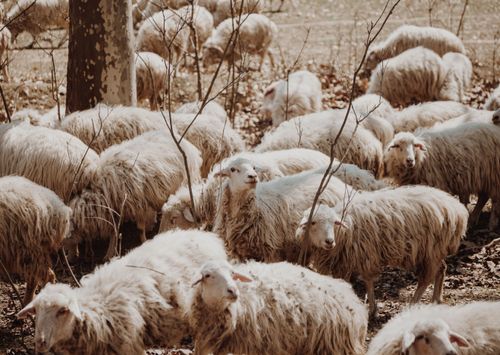
- Sheep: shallow, wide troughs with a roughened ramp or a few stones inside so a ewe that tumbles in can climb out. Deep buckets drown sheep.
- Pigs: nipple drinkers over a concrete pad, or a trough with rounded steel edges. Pigs will root a plastic trough out of the ground.
- Poultry: nipple lines or a covered drinker raised off the litter to keep water clean.
Stand every trough on a concrete plinth or a pad of hardcore. It keeps the base from rotting, stops the ground around it turning to liquid mud, and gives you somewhere solid to kneel while you fix the valve.
Pipework and the Frost Problem
Use blue MDPE pipe rated for potable water. It is flexible, tolerates ground movement, and will cope with being frozen once or twice if you are lucky. As a rough guide, 20mm suits a single trough on a short run, 25mm is the sensible default for a smallholding, and 32mm is worth the extra for long runs or several troughs off one line.
Bury pipe at 750mm where you can, and no less than 450mm elsewhere. Below 750mm the ground rarely freezes in a British winter. Where a run must come above ground — through a gateway, over a culvert, up to a trough — lag it heavily, sleeve it inside a larger pipe, and fit a drain valve at the lowest point so you can empty that section ahead of a hard frost.
Fit a stop tap at the head of every branch and an isolator at each field. When something bursts in February, being able to shut off one field instead of the whole holding is the difference between a nuisance and a disaster.
Storage, Head and Pressure
Aim for two to three days of storage as a buffer. Twenty cattle at 50 litres each is a tonne of water a day, so an IBC or two is a sensible minimum, and more if you are on a borehole, a spring, or a mains supply that you would rather not depend on.
Harvesting rainwater from a barn roof is straightforward: roughly 1 litre per square metre per millimetre of rain. A 100 square metre roof will give you around 1,000 litres from a decent 10mm downpour. Filter the first flush before it enters the tank so you are not storing leaf mould.
Gravity is free if you have the fall. Every 10 metres of head gives you about 1 bar of pressure, so a tank 5 metres above a trough delivers roughly half a bar — enough for a ball valve but not for a long narrow run. If your land is flat, use a small pump with a pressure switch and an accumulator, and make sure the pump housing is frost-free.
Lay Out the System Field by Field
Water is the reason livestock walk, and walking costs you condition and grass. No animal should travel more than about 200 to 250 metres to drink, and in a large field that usually means a dividing fence as much as an extra trough.
Site troughs on high, well-drained ground near a gateway where you can reach them with a quad and a trailer. Fence off a small apron around each one, or lay hardcore, so the approach does not become a bog. On a grazing rotation, put the trough at the point that serves two or three paddocks and move the fence around it, rather than plumbing each paddock separately.
The Routine That Prevents Repairs
Most water system failures are slow and boring rather than dramatic: a leaking ball valve, a furred-up fitting, a trough full of algae. Ten minutes a week saves a weekend in the mud.
- Check every trough at least twice a week and daily during hard frost or a heatwave.
- Scrub troughs monthly. Algae and muck put stock off drinking, and a ewe that will not drink will not milk.
- Test borehole or spring water annually for nitrates, iron and bacteria, especially if you have dairy or youngstock.
- Before winter, walk the whole line, operate every isolator, and drain any above-ground section.
- Keep spare ball valves, a coil of MDPE, a couple of straight couplers and a decent pipe cutter in the workshop. The repair you can do at dusk without a trip to town is the one that actually gets done.
Get the planning right and water stops being a daily worry. Clean, reliable supply through every gate is the quiet backbone of a well-run smallholding — and it is far cheaper to build properly than to patch forever.
tag: Tools & Kit

Emily Hartley Author
Add organic matter, avoid compacting wet ground and use raised beds to make heavy clay workable over several seasons.
YOU MAY ALSO LIKE
Improving Clay Soil in a Wet Garden
Sep 3
10Match horsepower, implements and manoeuvrability to your land size before buying a compact or vintage machine for daily work.
read more
Choosing a Tractor for Smallholding Tasks
Aug 31
10Position a pond away from trees, use native plants and allow natural colonisation to support frogs and insects.
read moreSmallholding
-

ERRIC CATONA
Choose mixed species, cut at the right time and protect young plants to create shelter and wildlife corridors.
May 19, 2016 at 5.12 pm
Reply
ERRIC CATONA
Harvest carefully, remove excess soil and store in cool dark conditions to keep carrots and beets fresh for months.
May 19, 2016 at 5.12 pm
Reply -
ERRIC CATONA
Compare electric tape, permanent posts and temporary netting to move animals efficiently across small fields without constant repairs.
May 19, 2016 at 5.12 pm
Reply
Land Management
Your email address will not be published.